In this article
The corporate website still matters. Its job has become more demanding.
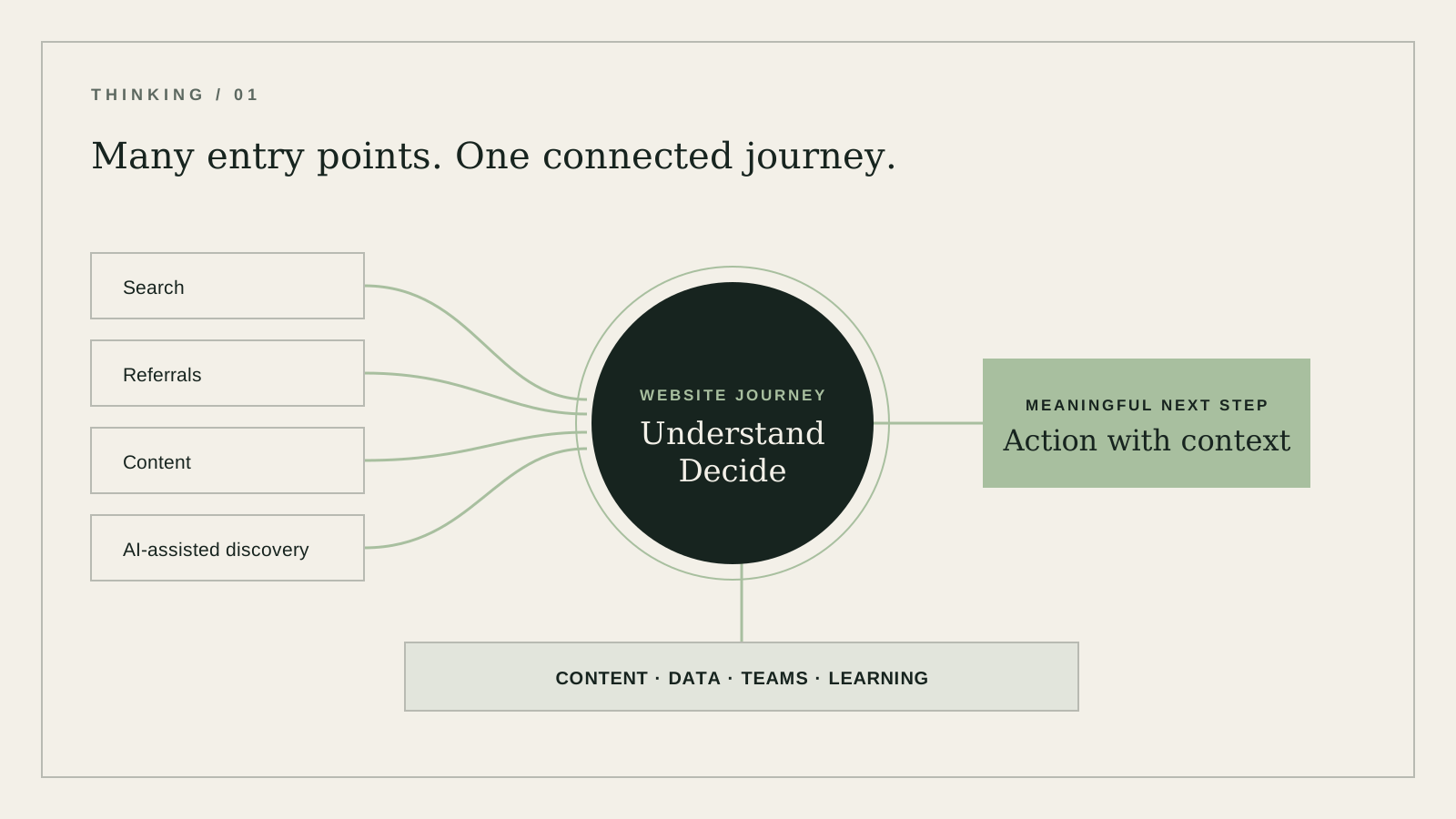
A prospective customer might first encounter a company through search, a colleague’s recommendation, a LinkedIn post, a comparison page or an AI assistant. They may arrive with a precise question and only a few minutes to decide whether to keep exploring. Later, another person on their team may need technical detail, commercial reassurance or proof that the first visitor did not.
The journey is rarely contained in one channel. In its 2024 B2B Pulse survey, McKinsey found that respondents used an average of ten ways to interact with suppliers during the buying journey. That is a survey average, not a target for every company. The useful question is whether someone can move between the relevant touchpoints without losing the thread.
In that journey, a website cannot succeed by looking polished at launch and remaining static until the next redesign. It has to help people make progress, while giving the organization a reliable way to improve what happens next.
That is the shift from a corporate website to a growth platform. “Platform” does not mean buying a larger stack or adding a chatbot to every page. It means connecting the experience people see with the content, data, decisions and ways of working behind it.
Start with the decisions people are trying to make
Most website plans begin with a list of pages: a new homepage, a better navigation, a refreshed product section. Those can be useful outputs. The stronger starting point is the set of decisions a visitor needs to make.
Can this company solve my problem? Which approach is right for my situation? What evidence can I share with colleagues? What should I do next, and what happens if I do?
These questions rarely belong to one page or one team. An answer may depend on clear product language, a credible example, a comparison, a useful conversation and a follow-up that remembers the visitor’s context. When those pieces are designed together, the site becomes more useful to the customer and more valuable to the business.
Consider a B2B buyer evaluating a complex service. They find a useful article, follow it to a service page and want to know whether the company understands their situation. A generic “Contact us” button gives them one path, regardless of what they still need to learn. A better experience explains how an engagement works, offers relevant proof and lets them ask a specific question or start a conversation. The team receiving that inquiry needs enough context to respond well. Content, experience design, measurement and follow-up all shape the result; the page is only the visible part.
Make discovery lead somewhere useful
Discovery is now spread across more places. That makes the website’s role more specific: it should be a dependable source of substance that can be found, understood and used wherever the conversation begins.
People need clear answers in the places they land, not only on the homepage. A service page should explain the problem, the approach, the likely outcomes and the limits of the offer. An article should develop an idea with enough depth to be worth reading on its own. The next step should follow naturally from that context.
This also improves what other channels can point to. A useful LinkedIn post can lead to a deeper article. A referral can send someone to the relevant service rather than a generic introduction. Search and AI-mediated discovery can surface well-structured, accurate information. Google’s guidance for AI features in Search says the established SEO fundamentals still apply: useful content, crawlability, internal links and important information in text. It does not promise inclusion in AI results. The underlying content still has to earn its place with clarity and relevance.
Connect the experience to the system behind it
Even a strong interface will lose value when the organization cannot keep it accurate or learn from it. A growth platform needs a workable system behind the visitor journey:
- Content with ownership: someone knows which questions each page answers, who maintains it and when it needs review.
- A coherent journey: navigation, proof and calls to action reflect the customer’s decisions across pages and channels.
- Useful measurement: teams can examine meaningful steps, recurring questions and places where a journey appears to stall.
- A delivery model: marketing, product, design, technology and commercial teams can prioritize improvements against shared outcomes.
These are connected choices. If a team measures only traffic, it may produce more pages without improving the quality of the conversation. If the content is useful but no one owns it, it becomes less trustworthy over time. If every change joins a request queue with no clear priority, the experience moves at the speed of internal negotiation.
The goal is a repeatable cycle: understand a customer need, decide what matters, improve the experience, observe what happens and adjust. That is how a website becomes a managed product rather than a sequence of launches.
Give AI a real job
AI can make parts of this system more capable. It may help a team organize a large content inventory, identify gaps in answers, support an editorial workflow or guide a visitor toward relevant information. The right application depends on the problem, the available data and the consequence of getting an answer wrong.
For example, an AI-assisted guide could help a visitor narrow options across a complicated offer. Before building it, the team needs to know which questions it may answer, which information is authoritative, when it should hand off to a person and how responses will be checked. The work may reveal that clearer content and a better comparison flow would solve much of the problem first. That is still progress: the goal is to improve the customer’s decision, not to justify an AI feature.
AI is most useful here as part of a designed experience and operating model. Human judgment remains necessary for positioning, quality, accountability and the decisions that affect customers. A promising demo becomes a useful capability when it can be maintained, measured and trusted.
Choose a starting point you can learn from
The path forward is usually smaller than a full redesign and broader than one isolated feature. Start with a customer decision that matters to the business. Trace the journey from discovery to the next meaningful action. Then examine the content, data, technology and team decisions that support it.
A first improvement might be a service journey that answers the buyer’s main questions and offers a relevant route to conversation. It might be a content model that keeps product information consistent across pages. Or it might be a clearer intake and prioritization process so the web team can focus on work that changes customer outcomes. Choose one journey, name the decision it supports and make the surrounding work visible.
Define what you expect to learn before you build. Look at the quality of the resulting conversations, the use of key content, the steps people take and the friction the team observes. Those signals will not all fit into a single dashboard, but together they can guide the next decision.
The corporate website has a stronger future when it becomes the place where experience and execution meet: useful to the people making decisions, and useful to the teams responsible for helping them move forward. AI can extend that capability. The foundation is the connected system around it.