In this article
My starting request was simple enough:
Help me turn my experience into a sellable service. Help me focus on my strengths, package the ideas and prepare them for testing.
I had experience to draw on. The question was which part of it should become the foundation of JFG·NEXT.
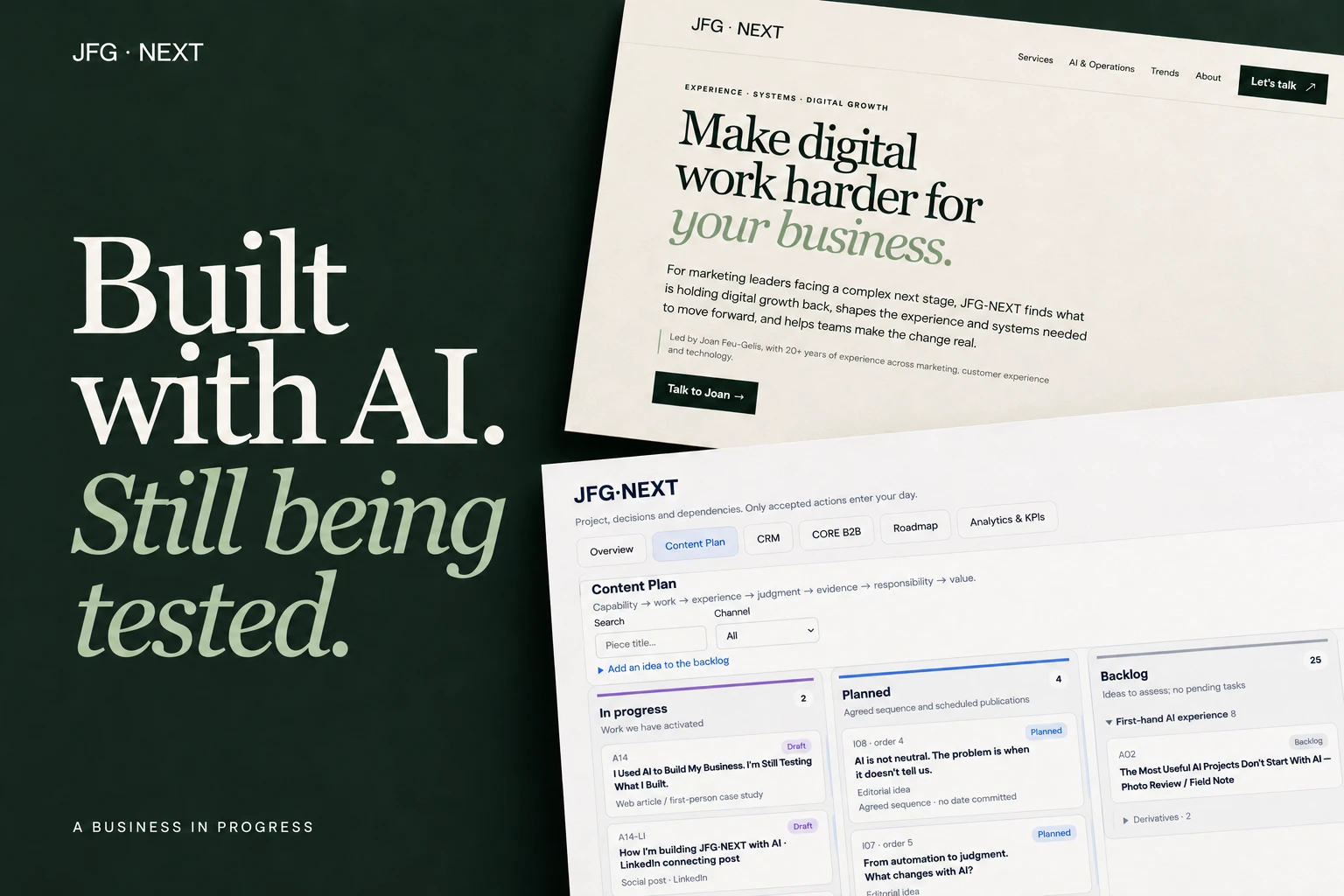
AI gave me a way to work through that question in conversation. From there, the work expanded into tangible things: an offer, a website and an editorial agent.
These are things I can now inspect, question and improve. They also make it easier to see what remains unresolved.
Giving experience a commercial shape
Experience rarely arrives in the form a buyer needs.
You carry situations you have worked through, decisions you have made and capabilities you have developed. A prospective customer wants to understand something more immediate: can you help with the problem in front of them?
Building JFG·NEXT meant trying to connect those perspectives.
Where could my experience be useful? Which strengths should I emphasise? How could I describe the work clearly enough for someone to decide whether a conversation would be worthwhile?
I used AI to help articulate possible answers and give the ideas a more concrete form.
That creates a useful object to work on. You can question a service description, narrow it or reject it. You can ask whether the promise reflects work you are equipped to deliver.
You still need evidence from potential customers. A convincing description helps you prepare that conversation; it doesn’t tell you what the answer will be.
The website made the questions harder to avoid
I also used AI to help build the JFG·NEXT website.
A website makes an offer public and specific. You need to choose what to say first, what deserves a page and what a visitor should understand about working with you.
Those choices bring the underlying business questions back into view.
Who is this for?
What problem am I describing?
What can I credibly contribute?
What should someone do after reading?
The site gave me somewhere to express those answers and review them in context. It also gave the editorial work a destination: a place to develop an argument beyond a LinkedIn post and connect it to what JFG·NEXT is trying to do.
But having a website does not settle whether the offer resonates. It gives me something concrete to put in front of people.
The editorial agent started with a recurring need
The next example came from a practical question: how could I develop and publish useful content consistently?
I wanted to bring in my own ideas alongside relevant material from newsletters and other sources. I wanted help assessing whether a topic was worth pursuing, what my angle could be and whether it belonged on LinkedIn, the website or both.
Then we needed a way to move from an idea to an outline, a draft, a review and a publication decision.
That became the editorial agent and its connection to the JFG·NEXT dashboard.
The dashboard holds the operational records: ideas, work in progress, planned pieces and published content. The editorial document holds the texts. I review the direction and decide what should move forward.
This is still a developing way of working. Building the parts has also exposed where the process needs attention.
The records drifted apart
At one point, I noticed that the dashboard, editorial calendar and agent were telling different stories.
Some published pieces still carried pending instructions. An article we were working on was being passed over in favour of a future idea. Dates and statuses needed reconciliation.
I use the dashboard as my reference, so this mattered. If I have to reconstruct the true state of the work from conversations and documents, the system is creating another job for me.
We checked the actual publications, corrected the existing records, closed the relevant tasks and reconciled the calendar. We also changed the agent’s instructions so it would consult the dashboard before proposing the next step.
The experience made a practical requirement much clearer: each part needs a defined role, and claims about what has happened need verification.
A planned date cannot prove that something was published. A completed draft cannot prove that it was approved. A successful save cannot prove that the result looks right when reopened.
These details determine whether I can rely on the process.
What I have built—and what I still need to learn
AI has helped me turn an intention into things I can work with: service propositions, a public website and tools to support editorial work.
I’m still testing how useful those things are.
The offer needs conversations with potential buyers. The website needs to help the right people understand where I can contribute. The editorial process needs to produce worthwhile work without requiring me to supervise every detail.
I don’t yet have a completed business case to present. I have a business taking shape and specific questions I can now test.
That is also influencing the kind of work I would like JFG·NEXT to do.
One direction I want to explore is helping companies organise their knowledge and connect tools to it, so people can work more coherently across audiences, messaging and content.
That is an emerging service idea. I would need to validate it with customers and demonstrate it in practice. My experience building JFG·NEXT is helping me formulate the questions.
Give yourself something concrete to test
If you are using AI to develop a business or a service, choose one thing you need to make clear.
It might be a service description. A page that explains the problem you solve. Or a recurring piece of work you want to organise more reliably.
Build enough to inspect it.
Ask what is grounded in your experience, what is supported by evidence and what remains an assumption. Check whether the result still holds up outside the conversation where it was created.
Then decide who needs to see it—and what you need to learn from their response.
That is how I’m approaching JFG·NEXT: using AI to make the work concrete, and keeping the next test in view.