IN THIS ARTICLE
I asked my AI editorial agent to write the next article in my content plan.
It delivered a complete draft: clear sections, sensible advice, a closing question.
I didn’t want to publish it.
The topic was how individual AI experimentation becomes a shared team practice. The draft explained how to share prompts, practise together and agree what good looks like.
Nothing was obviously wrong. But the article could have belonged to anyone.
We had a topic and a place in the calendar. We hadn’t established what I had to contribute.
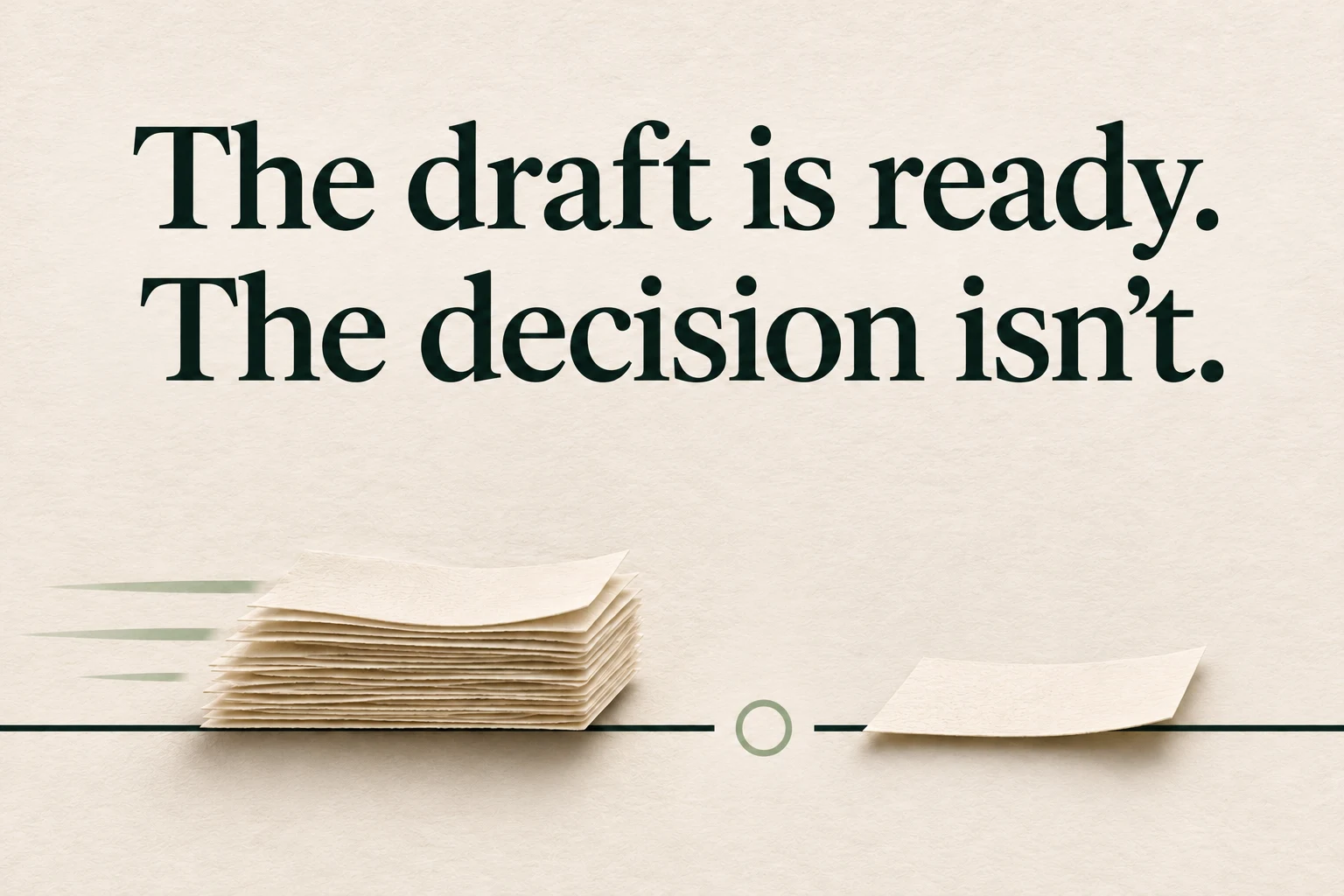
The writing had moved faster than the editorial decision.
The output arrived. The work wasn’t finished.
My next job was supposed to be reviewing the article. Instead, I had to step back and question its premise.
What had I observed? What did I disagree with? Why should someone read this piece rather than any other article about AI adoption?
Those questions belonged in the brief. The agent had filled the gaps with plausible prose.
That first draft still had value. Rejecting it helped us discover a stronger argument. But its finished appearance made it easy to overestimate how far we had progressed.
A rough page invites questions. A polished one invites edits.
We could have spent another round improving sentences without giving the article a reason to exist.
Someone inherits the unfinished thinking
The same problem can appear between colleagues.
Imagine a marketer uses AI to prepare three campaign directions. They arrive faster than expected, clearly written and visually convincing.
The reviewer opens them expecting to choose an execution. Then discovers that each option assumes a different audience or customer problem.
Before evaluating the creative, they have to reopen the brief.
Exploring three propositions can be useful. So can developing three executions of an agreed proposition. But they are different tasks, and they ask different things of the next person.
“Which direction do you prefer?” leaves the reviewer to uncover that distinction.
“These explore three customer problems; we need to choose one before developing the creative” makes the decision visible.
The handoff is part of the work. If it leaves someone else to recover the context and identify the unresolved questions, faster production may simply move effort from one person to another.
Fluency means recognising what the work needs next
Prompting, providing context and checking answers matter. I would also expect a capable AI user to judge whether another output will help.
In our editorial exchange, the useful next step was explaining why the first draft failed.
The example was hypothetical. The advice was familiar. There was no observation I could stand behind.
Once we identified that, we could work on the angle. Generating more prose before that decision would have given us more material to discard.
Sometimes the next useful action is checking a source, choosing between objectives or asking a colleague for knowledge missing from the brief.
People need enough judgment to recognise those gaps—and enough confidence to leave them visible.
“This is drafted, but the claim needs evidence.”
“These are options for discussion; we haven’t chosen a direction.”
“The copy is ready for review. The proposition is still unresolved.”
That precision lets the next person understand what they can use and what they are being asked to decide.
Make the judgment available to others
My initial feedback was simply that I didn’t like the article.
That expressed a reaction. Explaining why gave us something we could use again.
In a team, experienced reviewers often hold this knowledge without making it explicit. Colleagues hear “this isn’t us” or “it needs more work,” then try again.
AI makes those attempts easier to produce. It doesn’t automatically help anyone understand the rejection.
A useful way to build shared fluency is to examine real work together. Explain why an argument doesn’t hold, where a claim exceeds its evidence or what a reviewer still needs before making a decision. Let colleagues question that reasoning.
The aim is for people to recognise those issues earlier themselves.
That is how one person’s experience can become team capability. The learning travels with the work, instead of remaining with whoever approves it.
Did we save time—or pass it on?
For the next article, our brief should carry forward what this rejection taught us. We should establish the argument and supporting experience before producing a complete draft.
If we repeatedly generate from the same incomplete brief and reject for the same reasons, faster writing has done little to improve how we work.
The same test applies beyond content.
Follow the output to the next person. Can they act on it? Can they make the intended decision? Or must they reconstruct the thinking first?
My rejected draft gave us a better argument because we stopped treating its finished appearance as evidence that the editorial work was almost done.
A team needs that same permission—and the shared judgment to use it.
If the next person has to recover the context, uncover the assumptions and finish the brief, some of your saved time has become their workload.
Before calling the work faster, ask them.