IN THIS ARTICLE
When I look at an AI workflow in marketing, I want to know what happens when something changes after the work has been approved.
A good first draft shows that the tool can produce something useful. A change reveals whether the team can keep relying on the process.
Consider a product launch.
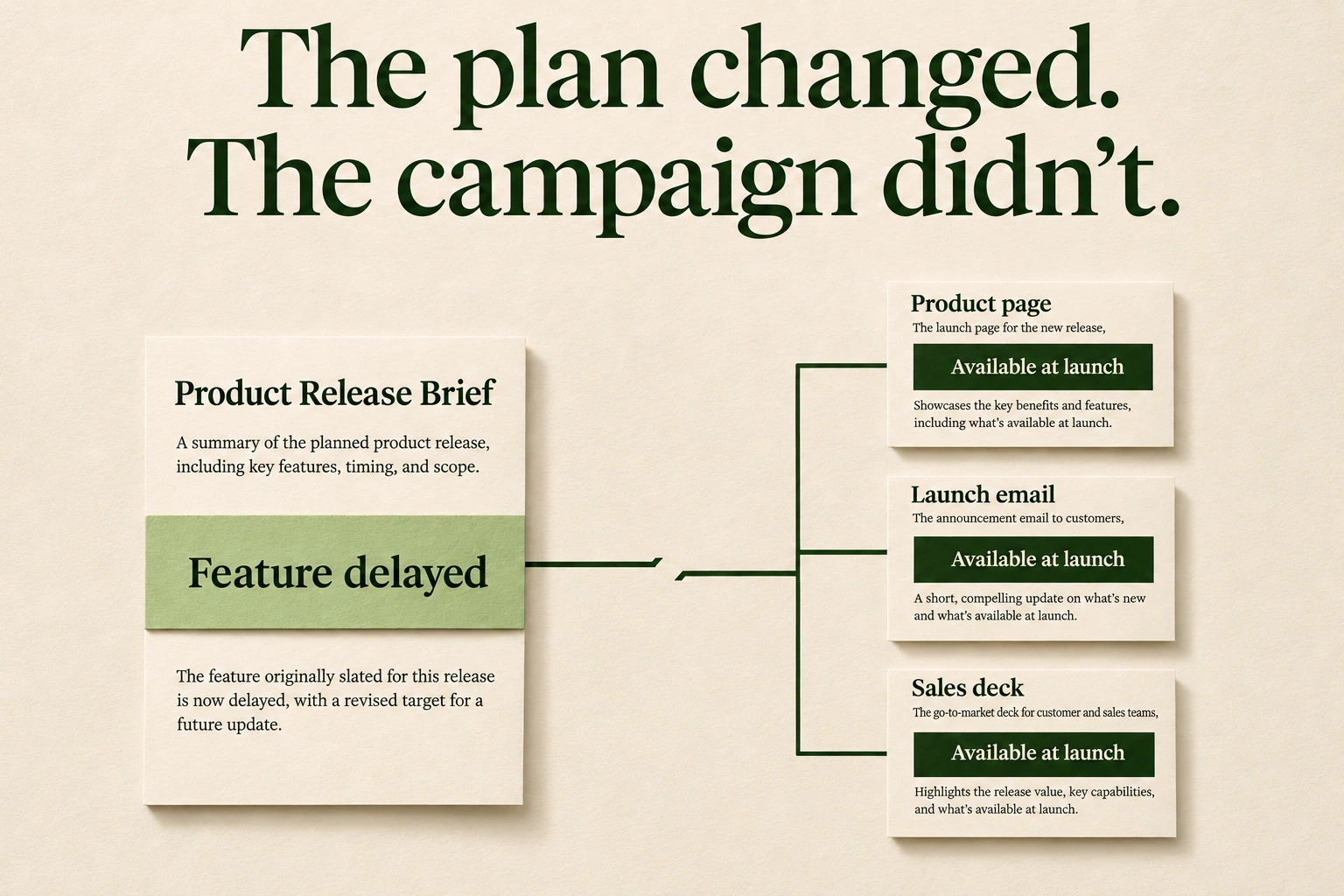
A week before release, the product team confirms that a feature promised at launch will arrive later. The product page is approved. The announcement email is ready. Sales has its deck. Social posts are scheduled.
The product decision has changed. The campaign still carries the old promise.
AI can help rewrite the materials quickly. Someone must still establish where that promise appears, which approvals need to be reopened and whether the campaign can go live.
That is where I would focus before automating more of the work. Otherwise, we make production faster and leave people to trace the consequences.
A workflow earns its place when the team can rely on it as the work changes.
The missing work sits between the outputs
“Write the launch email” is a reasonable request. Given accurate product facts, a clear audience and an agreed proposition, AI can produce a useful draft.
But the email belongs to a larger commitment. Its promises need to agree with the product page, the demonstration and what sales will say tomorrow.
The person creating it often holds that connection together. They know which document is current. They remember that a claim was softened in yesterday’s meeting. They recognise a screenshot that implies more than the product will deliver.
Much of that knowledge never reaches the prompt.
This can make an individual AI experiment look more repeatable than it is. The prompt works partly because someone is supplying the missing context and catching the mistakes around it.
Give the same prompt to a colleague and the result may look equally polished while resting on different assumptions.
Moving to a workflow means deciding which of those assumptions must become explicit, where they belong and who keeps them current. That is operating work. Connecting tools comes after it.
The customer promise needs a home
In the launch example, I would start with a deceptively simple question: where does the team go to establish what it can promise?
The roadmap, product brief, messaging document and sales deck may all contain plausible answers. They were written for different purposes and updated at different times. An ambition on a roadmap is not necessarily a capability available at launch.
A workable process needs an agreed account of the facts relevant to this release: what is available, for whom, under what conditions and what remains uncertain.
It also needs someone who can resolve a disagreement.
That could live in a short release brief inside an existing tool. It does not require buying a platform or creating a document for every decision. It requires people to know which information governs this work.
AI can then use those facts, surface contradictions and ask for missing information. It should not have to decide which team’s document to believe.
The customer will never see the release brief. They will experience whether the company keeps its promise.
Approval belongs to a version
“Approved” is useful shorthand until we forget what was approved.
An email was approved with particular wording, based on particular facts. Changing those facts can invalidate the approval even if nobody touches the email.
That is the important transition in our illustrative launch. Removing the feature from the product plan should make the affected marketing work visible for review again.
It should not automatically reopen everything.
A punctuation correction, a new image crop and a change to product availability have different consequences. Treating them identically either creates needless review or lets consequential changes pass too easily.
I would want the workflow to reflect that distinction.
AI can help identify where the feature appears, compare the approved version with the proposed revision and explain why each asset may be affected. Direct references are relatively straightforward to find. An implication in a screenshot or demonstration may need a person’s attention.
The reviewer should receive a decision they can actually make: this promise has changed; these materials appear to depend on it; here are the revisions and the unresolved questions.
That is far more useful than another message saying, “Please review the updated campaign.”
The approval process should make the change easier to judge. Asking for approval is not enough.
Automation can preserve the wrong thing
Making a workflow dependable does not mean freezing every decision made at the beginning.
Removing a feature may require more than deleting a sentence. If that feature carried the main reason to buy, the original campaign proposition may no longer hold.
A perfectly coordinated workflow could remove every reference, update every asset and deliver a consistent campaign with very little left to say.
That is where I want marketing judgment to interrupt the sequence.
Does the remaining product still support the proposition? Should the message change? Should the launch become smaller, move later or proceed with a different emphasis?
AI can surface the dependency and help explore the alternatives. The decision requires someone who understands the customer, the product and the commercial priorities.
The workflow must leave room for that decision. Otherwise, it makes the original plan increasingly efficient to execute after the reason for it has changed.
A useful pause protects progress
Real work includes missing information, unavailable people and tools that cannot complete the next step.
Suppose the page and email have been revised, but nobody has confirmed which sales deck is in circulation. Or the scheduled post cannot be inspected.
The workflow should preserve what has been completed and make the remaining uncertainty specific.
Which material is affected? What has been checked? What is still unknown? Who can resolve it?
Those answers let the team contain the problem. An unverified launch claim may prevent a release. It need not stop unrelated preparation.
They also make resuming safer. Before acting again, the process needs to check whether someone has already corrected the deck, changed the schedule or made a newer decision. Repeating the previous action can overwrite progress or create duplicates.
I would rather have a workflow pause with a precise account of what it needs than continue by making a plausible assumption.
That preference has a condition: the pause must help someone move the work forward. A vague error simply hands the investigation back to the team.
Put the checks close to the consequence
There is a cost to all of this. Maintaining current inputs, defining change boundaries and checking results takes effort.
For an occasional, low-risk task, a good prompt and an attentive person may be enough. Turning every request into a formal workflow would burden the team with maintaining processes it rarely uses.
The case becomes stronger when the work repeats, crosses several people or systems, or makes promises that matter to customers.
Even then, the aim should be fewer unnecessary checks and better consequential ones.
Some checks can be automated: whether required information is present, whether a link works or whether an asset contains a superseded claim. Others need judgment: whether a qualification is prominent enough, whether the demonstration misleads or whether the revised proposition remains worth launching.
A human does not need to reread every output simply because AI helped create it. They need to see the parts where their decision changes what should happen.
And completion needs to be checked where the result is used. A successful save confirms that something was saved. It does not establish that the public page is correct or that sales has the version it should use.
The useful evidence follows the customer consequence.
Start with one handoff the team struggles to trust
I would not begin by automating an entire launch.
I would choose one recurring piece of work where people regularly have to chase context, clarify approval or check whether something actually happened.
Work through it with the people on either side. Establish what the next person needs to rely on, which changes would invalidate that confidence and who can resolve an exception.
Then decide what AI should carry.
It might assemble the relevant inputs, find affected materials, prepare changes or run routine checks. It might also make a gap visible early enough that the team avoids producing work it will have to discard.
The first improvement may be a clearer decision rather than another automation.
That is a useful result. It tells us what the process was missing.
The Marketing OS becomes practical in these connections: agreed knowledge enters the work, judgment shapes what can proceed, and the result returns with evidence that people can use.
Before asking how many steps AI can perform, I would ask how much the next person still has to reconstruct.
If they must rediscover the current facts, work out which approval still holds and determine whether the result is usable, we have automated some tasks.
The workflow is still theirs to finish.