In this article
Consider a hypothetical product announcement.
A company wants to describe its product as “AI-enabled.” The marketing team can generate a first draft in minutes. It reads well. The benefits sound compelling.
Then the questions begin.
What can customers actually use today? Is the capability available to everyone? What does it improve? Can the company support the proposed claims? What information does legal need to assess them?
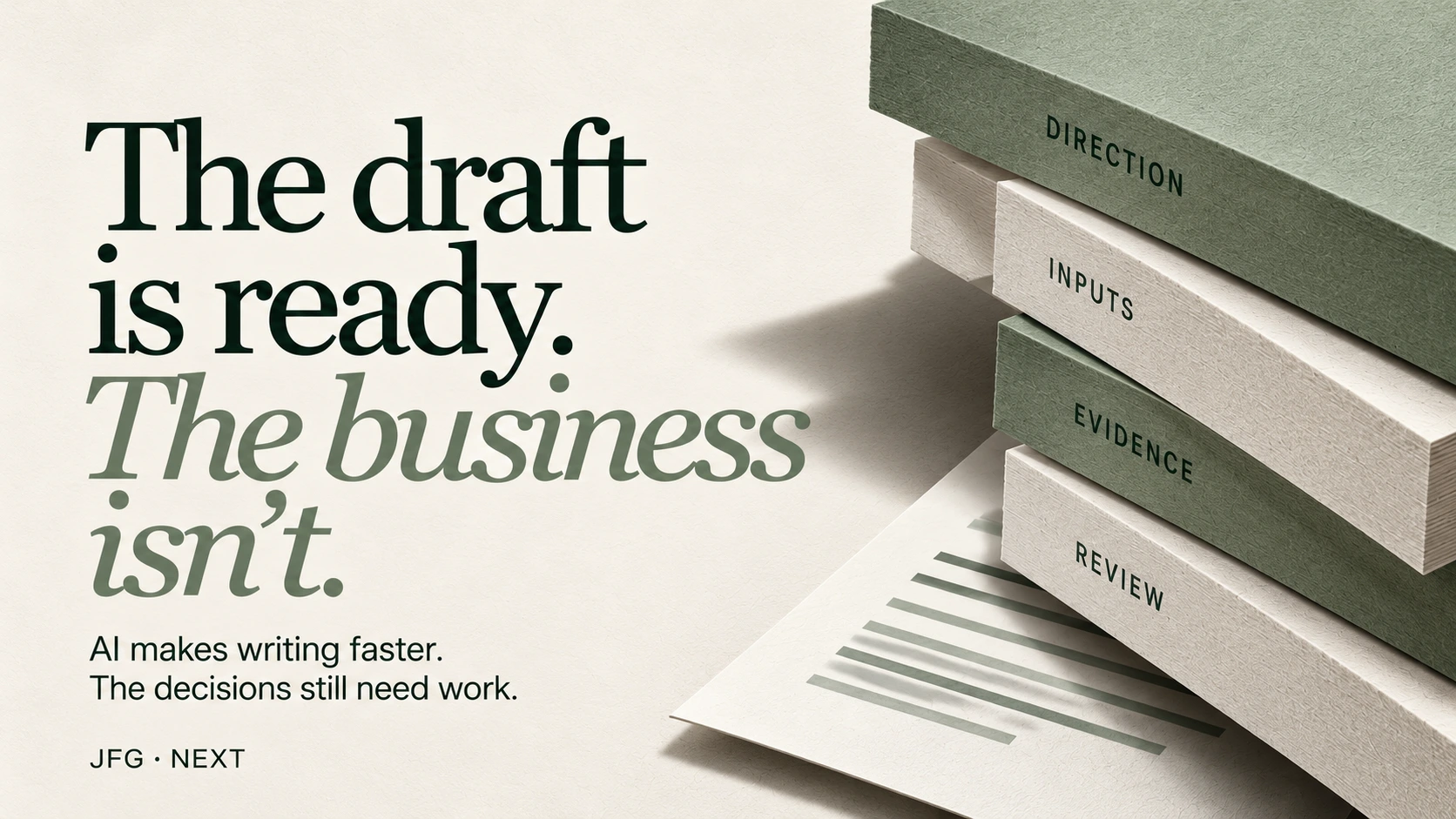
The writing moved quickly. The decisions around it remain open.
AI can make a valuable part of marketing work faster. But the time it takes to produce a draft is only one part of the time it takes to deliver something useful.
Agree what the work needs to achieve
In my experience, some of the hardest work happens before anyone starts writing.
People may agree that an announcement is needed while holding different views about its purpose. Product wants to explain a capability. Sales wants a stronger competitive story. Marketing wants a clear position. Each perspective can be reasonable, but the draft cannot settle those differences on its own.
A fluent version can even make agreement look closer than it is. Everyone recognises something they like in the language, until they examine the specific claims.
Before generating more versions, I would want a few decisions made explicit:
- Who is this for?
- What should they understand or be able to decide?
- What can we credibly say today?
- What should happen after they read it?
AI can help compare proposed directions and expose disagreements. Someone still needs to resolve them.
Give the draft reliable inputs
A writing brief is only as useful as the information behind it.
A product document may describe the intended experience. A presentation may contain an earlier version of the positioning. A conversation may introduce an important qualification that never reaches either document.
Put all three into an AI tool and it may produce a coherent account without recognising which source should take precedence.
The team needs a way to distinguish current facts, approved decisions, proposals and unanswered questions. That does not necessarily require a new platform. It does require clear sources and people who can resolve uncertainty.
AI can organise that material, identify conflicts and flag missing answers. Those gaps should remain visible until someone validates them.
Build the argument with evidence
“This feature uses AI” and “this feature helps customers achieve a better result” are different claims.
The second needs support. What changed for the customer? Under which conditions? Is there a demonstration, a measured result or a customer account that supports the wording?
Without that connection, teams can spend several rounds polishing a sentence that needs a narrower claim.
I find it useful to put consequential claims beside their supporting evidence before refining the copy. Where evidence is incomplete, the team can decide to qualify the statement, explain the limitation or leave it out.
AI can help prepare that comparison. It should not fill the gaps with plausible benefits.
Make review easier to do well
Legal review is often where unresolved questions become visible.
A reviewer receives polished copy, but may still need to establish what is available, where a number came from or whether an example represents a typical outcome.
Those are substantive questions. Sending the draft earlier may help, but sending the relevant context matters too.
For a claim that needs careful review, I would include its source, important qualifications and any remaining uncertainty. Where appropriate, I would involve reviewers while the team is shaping the claim, before the wording starts to feel final.
The aim is to give people what they need to exercise their judgment.
Improve the whole workflow
AI creates an opportunity to rethink how marketing work moves.
For one recurring type of work, a team could agree the intended outcome, identify authoritative inputs, connect claims to evidence and define the review path. Then it can decide where AI contributes.
That contribution might include organising source material, comparing messages, preparing drafts or checking whether the final copy reflects the approved decisions.
To understand whether the change helped, I would look beyond writing time: how long the piece took to become usable, how much rework it needed and whether it helped its audience take the intended next step.
A useful place to start is one piece that has stalled.
Ask what remains unresolved. Is it the direction, the information, the evidence or a decision needed for review?
The answer tells you something important about where to improve the work—and where faster drafting will help.
At JFG·NEXT, I help leaders connect customer experience, content, technology and the way teams work. If this pattern feels familiar, I’d be glad to discuss where your work is getting stuck.